Salons, barbershops, clinics, studios and anyone taking bookings against fixed capacity, and the managers who have to justify an overbooking rule.
How it works
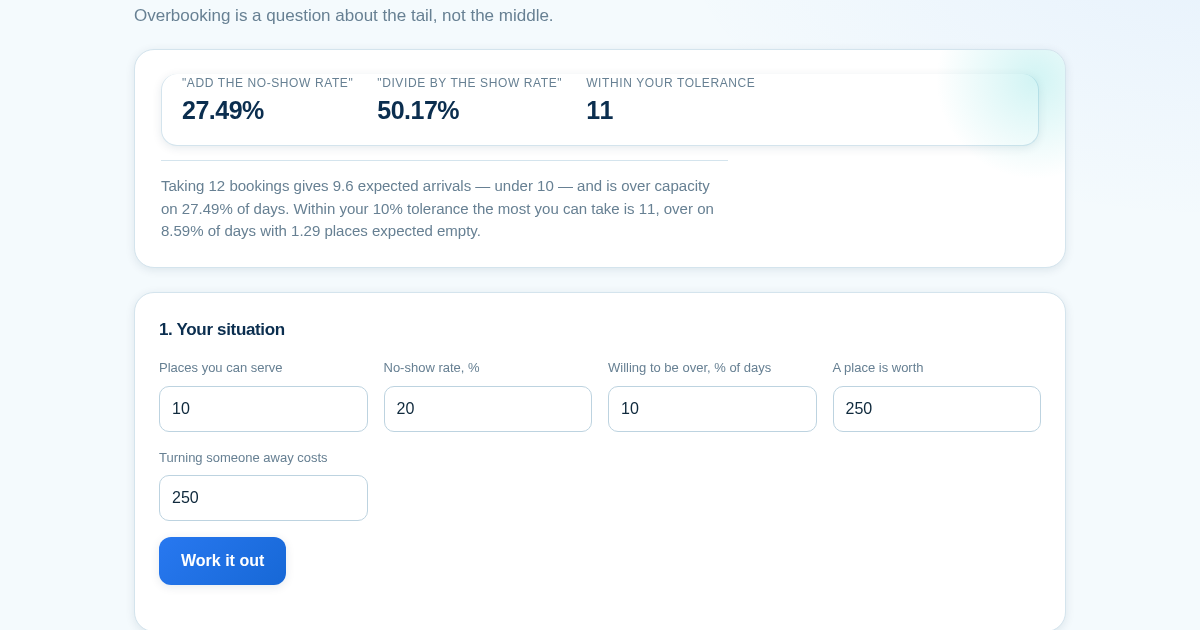
- Enter your places, your measured no-show rate, and how often you are willing to be over.
- Compare the two rules of thumb — and the risk each one silently accepts.
- Read the largest booking count that stays inside your tolerance.
- Look at the whole table: empty places against turned-away customers is the trade you are making.
What you gain
- Tells you how often you'll actually end up over capacity at a given booking level — not just the average number of no-shows — so overbooking becomes a chosen risk instead of a guess.
Screenshot
Technical details
How to set up & use
- Buy the license — your key (lic_...) appears on the order page and in your email.
- Sign in at app.synoriaai.com with your license key.
- No installation — the product runs in your browser, on your own isolated instance.
- Enter your capacity, the expected no-show rate, and how often you are willing to be over capacity.
- Click 'Calculate' to see the two common rules of thumb and their over-capacity probabilities.
- Review the suggested booking count that stays within your tolerance, along with its exact over-capacity percentage.
- Check the verdict line to see the expected arrivals and confirm the result matches your risk preference.
Frequently asked questions
Is my data safe?
Yes, all calculations happen in your browser. No data is sent to any server, and nothing is stored.
What does this tool not do?
It does not account for correlated arrivals (e.g., parties, weather, holidays), so real over-capacity risk may be higher than shown. It also does not merge risk and cost into one recommendation.
Why do the two rules of thumb give different results?
They use different arithmetic—adding the no-show rate versus dividing by the show-up rate—so they yield different booking counts and over-capacity probabilities. The tool shows both for comparison.
Related products
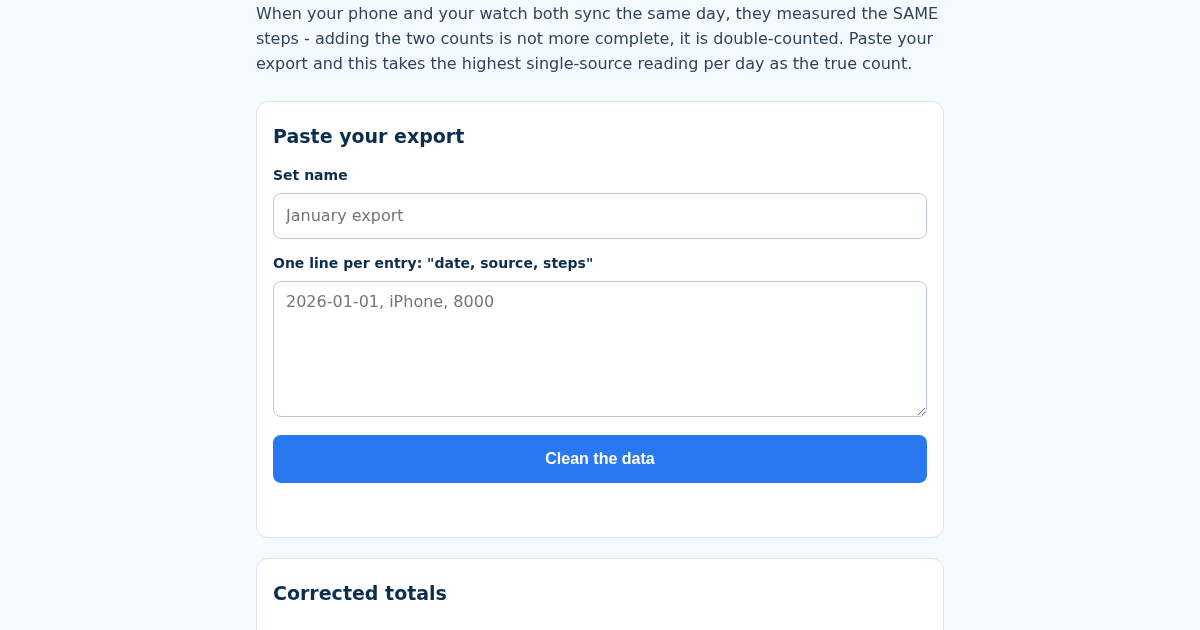
HealthClean: Health Data Export Cleaner for Wearables
When your phone and your watch both sync the same day's walk, most people's instinct - and some naive export tools - just add the two step counts together. That is not a more complete number, it is double-counted: both…
HealthClean: Health Data Export Cleaner for Wearables
When your phone and your watch both sync the same day's walk, most people's instinct - and some naive export tools - just add the two step counts together. That is not a more complete number, it is double-counted: both…
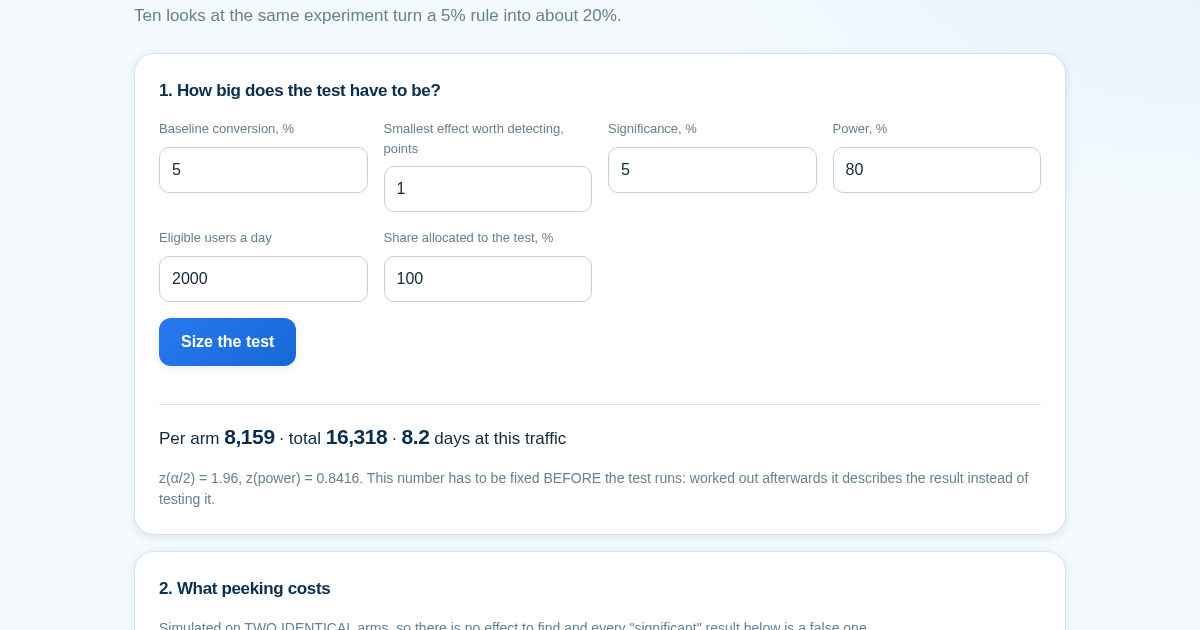
Stopping at Significance Isn't a 5% Test
Checking a test once gives roughly the 5% false-positive rate you asked for. Checking ten times along the way and stopping at the first crossing gives about 20%, and twenty times gives about 24% - simulated here on two…
Stopping at Significance Isn't a 5% Test
Checking a test once gives roughly the 5% false-positive rate you asked for. Checking ten times along the way and stopping at the first crossing gives about 20%, and twenty times gives about 24% - simulated here on two…